
Sponsorship and salary F2018L00284
Annual earnings amount and annual market salary rate method: IMMI 18/033
IMMI 18/033 specifies the $250,000 annual earnings amount used in employer-sponsored nominations and sets the methods for determining the annual market salary rate (AMSR) of a nominated occupation.
The Migration (IMMI 18/033: Specification of Annual Earnings and Methodology of Annual Market Salary Rate) Instrument 2018 (IMMI 18/033) was signed on 15 March 2018 by the Minister for Citizenship and Multicultural Affairs, registered on 16 March 2018 and commenced on 18 March 2018. Section 3 lists the provisions of the Migration Regulations 1994 it is made under: paragraph 2.72(15)(b), subregulation 2.72(17), paragraph 2.72C(15)(b) and paragraph 2.79(1A)(b). The latest compilation is Compilation No. 7, in force from 1 July 2026, which includes amendments up to LIN 26/074.
The explanatory statement to the instrument as made states that its purpose was to address changes to the Regulations by the Migration Legislation Amendment (Temporary Skill Shortage Visa and Complementary Reforms) Regulations 2018
. As made, it also specified the temporary skilled migration income threshold in section 6, at AUD 53,900.
Annual earnings amount
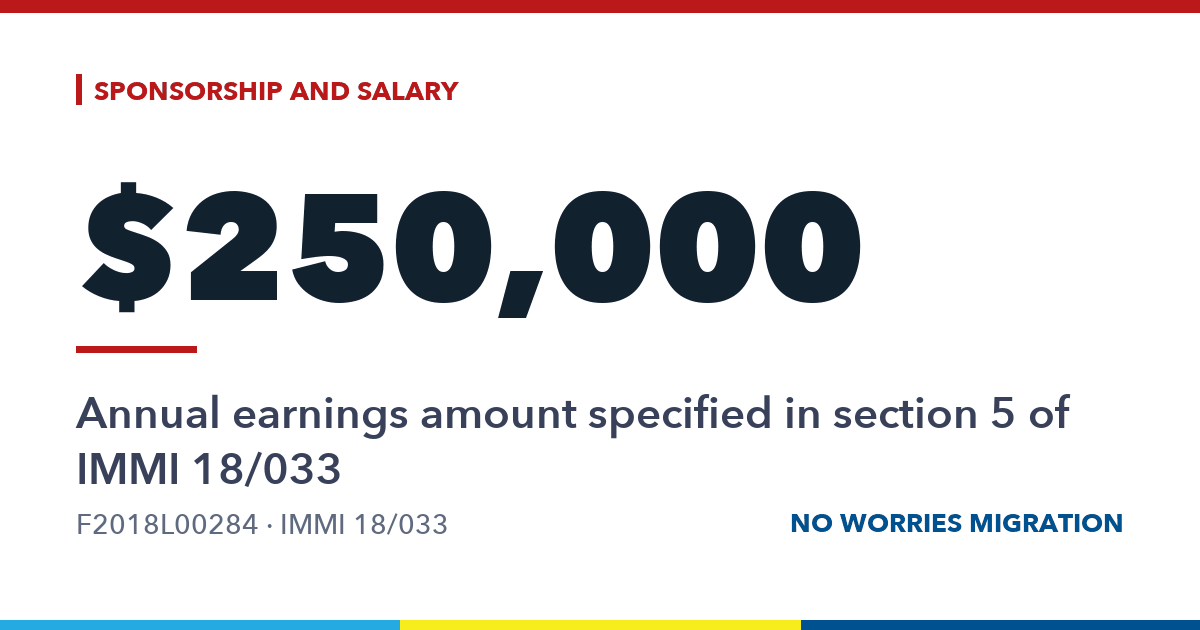
Section 5 specifies the amount of annual earnings for paragraphs 2.72(15)(b), 2.72C(15)(b) and 2.79(1A)(b) of the Regulations as AUD 250,000. The explanatory statement to LIN 26/038 describes the effect: where a nominee will earn less than this amount per annum, the Minister must be satisfied the nominee will be paid at least the AMSR, excluding non-monetary benefits.
How the annual market salary rate is determined
Sections 7 and 8 set the method for subregulation 2.72(17). Both were substituted by LIN 26/038 (F2026L00329) from 25 March 2026. The explanatory statement to LIN 26/038 states that it allows flexibility in determining the AMSR in circumstances where there is a relevant Fair Work instrument, state industrial instrument or transitional instrument
.
| Situation | Equivalent Australian worker in the same workplace and location (s 7) | No equivalent Australian worker (s 8) |
|---|---|---|
| A fair work instrument, state industrial instrument or transitional instrument applies | The annual earnings specified in that instrument, or relevant employment documents if the earnings are not less than the instrument amount (s 7(2)) | The annual earnings an equivalent Australian worker would receive under that instrument, or relevant information if the earnings are not less than the instrument amount (s 8(2)) |
| No such instrument applies | The annual earnings of the equivalent Australian worker, from relevant employment documents (s 7(3)) | The annual earnings that would apply to an equivalent Australian worker, from relevant information (s 8(3)) |
Section 4 defines both evidence terms. Relevant employment documents include pay slips and a contract of employment. Relevant information includes Jobs and Skills Australia Occupation and Industry Profiles, English-language job advertisements on a national recruitment website or in national print media that state the salary, written advice from registered employer associations or unions, and industry remuneration surveys by a reputable organisation. Section 14 applies the 2026 methods to nominations made on or after 25 March 2026 and to nominations made but not decided before that date.
Income threshold section repealed from 1 July 2026
Schedule 2 to LIN 26/074 (F2026L00877) repealed section 6 (Income Threshold) and paragraph 3(d), and removed “Income Threshold and” from the instrument’s name and the Part 2 heading, from 1 July 2026. The threshold is now defined in regulation 1.03 of the Migration Regulations 1994 as $79,423 for nominations made on or after 1 July 2026. Section 6 had last been amended by LIN 25/038, which set AUD 76,515 for nominations made on or after 1 July 2025 (section 13).
Which nominations it applies to
Section 9 applies the instrument to nominations made on or after 18 March 2018 by a standard business sponsor, an applicant for approval as one, or a party to a work agreement or to negotiations for one (other than the Minister), in relation to subclass 457 and subclass 482 visa holders and applicants. The note to section 9 states that the Regulations extend it to other visas through subregulations 2.72C(15) and (16), 2.79A(2) and paragraphs 5.19(5)(o) and 5.19(9)(h). Sections 10 to 14 are application provisions for the amendments made by LIN 23/045, LIN 24/052, LIN 24/094, LIN 25/038 and LIN 26/038.
Questions and answers
What is the annual earnings amount in IMMI 18/033?
AUD 250,000, under section 5, for paragraphs 2.72(15)(b), 2.72C(15)(b) and 2.79(1A)(b) of the Migration Regulations 1994.
Can the AMSR be based on pay slips where an award applies?
Since 25 March 2026, where a fair work instrument, state industrial instrument or transitional instrument applies, the AMSR may be determined by relevant employment documents (section 7(2)(b)) or relevant information (section 8(2)(b)), provided the annual earnings are not less than the amount under that instrument.
Does IMMI 18/033 still set the TSMIT?
Section 6 was repealed by LIN 26/074 from 1 July 2026. For a nomination made on or after that date the TSMIT is $79,423 under regulation 1.03 of the Migration Regulations 1994.
Sources
- Migration (IMMI 18/033: Specification of Annual Earnings and Methodology of Annual Market Salary Rate) Instrument 2018, F2018L00284, Federal Register of Legislation
- Explanatory statement to IMMI 18/033 (as made), F2018L00284
- Migration Legislation Amendment (Annual Market Salary Rate) Instrument 2026 (LIN 26/038), F2026L00329
- Migration (Nil VAC Arrangements and Other Matters) Instrument 2026 (LIN 26/074), F2026L00877
- Migration (IMMI 18/033) Amendment (Annual TSMIT Increase) Instrument 2025 (LIN 25/038), F2025L00731
- Migration Regulations 1994, regulation 1.03
Instruments are amended and replaced. The version that applies to an application is usually the one in force on a particular date, which may not be the current one.
Full guide: Employer sponsored visas
Back to the legislation library