
Fees and charges
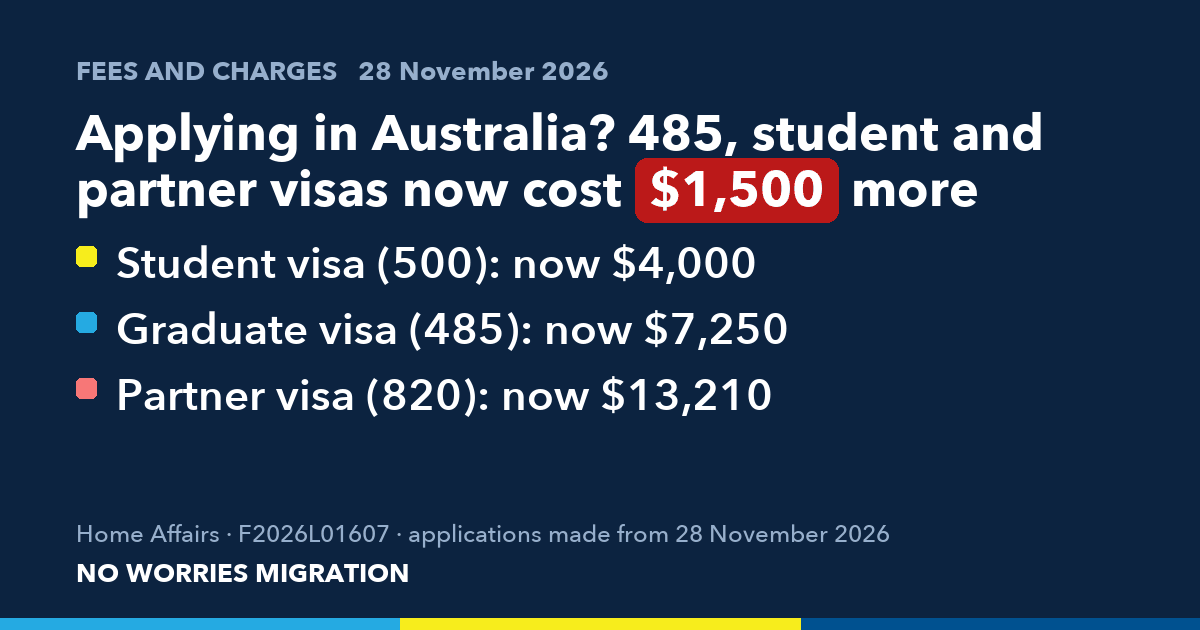
Onshore application charge: 485, student, partner and parent visas now cost $1,500 more per person
The onshore application charge adds $1,500 per applicant to 485, student, onshore partner, parent and some family visas applied for in Australia from 28 November 2026.
Does this change affect you? Book an appointment to discuss your situation.
The onshore application charge is now law. The Migration Amendment (Onshore Application Charge and Other Measures) Regulations 2026 (F2026L01607) were made on 26 November 2026 and commence on 28 November 2026. They add a charge of $1,500, called the onshore application charge, to the first instalment of the visa application charge for nine classes of visa, including the Temporary Graduate (subclass 485), Student (subclass 500), onshore Partner (subclass 820/801) and onshore parent visas. It is payable for each applicant who is in Australia when the application is made, and for family members included in an application whose main applicant is in Australia.
The explanatory statement says the charge is part of the 2026–27 Budget and supports the reform of the migration system, including encouraging, where appropriate, certain visa applications to be lodged offshore rather than onshore
.
Key dates
| Date | What happens |
|---|---|
| 26 November 2026 | Regulations made (F2026L01607) |
| 27 November 2026 | Registered on the Federal Register of Legislation |
| 28 November 2026 | Regulations commence. The charge applies to visa applications made on or after this date |
The Regulations add Part 169 to Schedule 13 of the Migration Regulations: the amendments apply in relation to an application for a visa made on or after the commencement
. An application made before 28 November 2026 does not pay the new charge.
Which visas carry the onshore application charge
| Visa class in the Regulations | Subclasses (from the explanatory statement) |
|---|---|
| Skilled (Provisional) (Class VC) | 485 Temporary Graduate |
| Student (Temporary) (Class TU) | 500 Student, 590 Student Guardian |
| Partner (Residence) (Class BS) | 801 Partner (the onshore 820/801 application) |
| Child (Residence) (Class BT) | 802 Child, 837 Orphan Relative |
| Other Family (Residence) (Class BU) | 835 Remaining Relative, 836 Carer, 838 Aged Dependent Relative |
| Aged Parent (Residence) (Class BP) | 804 Aged Parent |
| Contributory Aged Parent (Residence) (Class DG) | 864 Contributory Aged Parent |
| Contributory Aged Parent (Temporary) (Class UU) | 884 Contributory Aged Parent (Temporary) |
| Extended Eligibility (Temporary) (Class TK) | 445 Dependent Child |
The charge applies only to the classes in this table. Visas outside it, for example the offshore Partner visa (subclasses 309 and 100), the offshore parent visas and the skilled visas such as the 189, 190, 482 and 186, are not in the table.
How much the first instalment is now
These are the Department’s own figures from its Visa Pricing Estimator, checked on 28 November 2026, for a main applicant applying alone online. The onshore application charge is added when the application is made in Australia; the 485 and the 820/801 can only be applied for there. The subsequent temporary application charge can apply on top for some temporary visas.
| Visa | Base charge, main applicant | With the onshore application charge |
|---|---|---|
| Temporary Graduate (485), most applicants | $5,750 | $7,250 |
| Student (500), most applicants | $2,500 | $4,000 |
| Student Guardian (590) | $2,500 | $4,000 |
| Partner (820/801) | $11,710 | $13,210 |
| Aged Parent (804) | $6,600 | $8,100 |
| Child (802) | $4,040 | $5,540 |
The charge is per person. For a 485 applicant in Australia with a partner and a child, the Department’s estimator now shows $14,575: the $5,750 base charge, $2,875 for the partner, $1,450 for the child, and three onshore application charges of $1,500. Without the onshore charge the same family paid $10,075. Our visa fee calculator shows the Onshore Application Charge line for your own application, from the Department’s estimator.
Who pays: in Australia at the time of application
The new subregulation 2.12C(10) makes the charge payable if, at the time of making the application, the applicant is in Australia, or, where the application is combined with the application of the main applicant, either that applicant or the main applicant is in Australia. A family member overseas who is included with a main applicant in Australia therefore pays it too.
Main applicants for the subclass 485 can only apply in Australia. The explanatory statement says family members applying with them are not required to apply from the same place as the primary applicant
, and that the charge would therefore also apply to applicants included in a combined Subclass 485 visa application
. Our 485 visa guide sets out the rest of the 485 requirements.
Who does not pay
The charge attaches only to particular rows of each visa’s charge table, so some applicants stay on their existing charge. The explanatory statement lists them:
- holders of a valid passport issued by a Pacific-regional country, for the visas that have a Pacific-regional charge;
- subclass 500 applicants holding a valid passport of an ASEAN country specified in subitem 1222(5A): Brunei, Cambodia, Indonesia, Laos, Malaysia, Myanmar, the Philippines, Singapore, Thailand and Vietnam;
- subclass 500 applicants enrolled in an ELICOS or a non-award course;
certain visa applicants for certain specified visas, where there is an option to apply outside Australia
(the explanatory statement gives subparagraph 1211(3)(aa) as its example).
For the 485, the charge attaches to the $5,750 row and to the $2,265 row (a second 485 for a Post-Higher Education Work visa holder). The two Pacific-regional rows, $2,360 and $930, do not carry it.
Also in these Regulations: subclass 202 charge
Part 2 increases the base application charge for the Global Special Humanitarian visa (subclass 202) from $570 to $580. The explanatory statement says this corrects an indexation increase that was left out of the July 2026 Regulations.
Questions and answers
What is the onshore application charge?
A charge of $1,500 added to the first instalment of the visa application charge for nine classes of visa, including the 485, student, onshore partner and onshore parent visas, when the application is made in Australia. It is in new subregulation 2.12C(10) and (11) of the Migration Regulations.
How much is the onshore application charge?
$1,500 for each applicant it applies to, including family members and children in the same application.
When does the onshore application charge start?
On 28 November 2026. It applies to applications made on or after that date. Applications made before it do not pay it.
What is the 485 visa fee in 2026?
For most main applicants, $5,750 plus the $1,500 onshore application charge, so $7,250 from 28 November 2026. Main applicants can only apply in Australia, so they pay it unless they are on a Pacific-regional row.
What is the 485 visa fee with dependent family members?
Each family member adds the additional applicant charge ($2,875 for 18 and over, $1,450 under 18) and a $1,500 onshore application charge each. The Department’s estimator shows $14,575 for a main applicant, partner and child.
Is there a student visa fee increase in Australia in 2026?
Yes, for students applying in Australia. From 28 November 2026 most subclass 500 applicants in Australia pay $2,500 plus $1,500, so $4,000 for the main applicant. Students applying from outside Australia stay at $2,500.
Do I pay the onshore application charge if I apply for a student visa from outside Australia?
Not if you are outside Australia when you apply and nobody in your application is in Australia. The charge depends on where the applicant, or the main applicant, is at the time the application is made.
Are ASEAN students exempt from the onshore application charge?
Yes, for the subclass 500 with a valid passport from Brunei, Cambodia, Indonesia, Laos, Malaysia, Myanmar, the Philippines, Singapore, Thailand or Vietnam.
Do ELICOS students pay the onshore application charge?
No. Subclass 500 applicants enrolled in an ELICOS or non-award course stay on their existing charge.
What is the partner visa 820 fee in 2026?
The Department’s estimator shows $11,710 for the main applicant, plus $1,500 for an application made in Australia, so $13,210 from 28 November 2026.
Is the partner visa fee 2026 higher for the 309 offshore partner visa?
Not because of this charge. The offshore Partner visa (Class BC, subclasses 309 and 100) is not one of the classes in the table.
Do children pay the onshore application charge?
Yes. The Department’s estimator charges $1,500 for each applicant, including children under 18.
My partner is overseas but I am in Australia. Do they pay the onshore application charge?
Yes, if they are included in your application and you are the main applicant in Australia. The charge applies where either that applicant or the main applicant is in Australia when the application is made.
I applied before 28 November 2026. Do I have to pay the new charge?
No. Schedule 13 Part 169 applies the amendments to applications made on or after 28 November 2026.
Does the onshore application charge apply to parent visas?
To the onshore parent visas: Aged Parent (804), Contributory Aged Parent (864) and Contributory Aged Parent (Temporary) (884). The offshore parent visas are not in the table.
Does the onshore application charge apply to the 590 Student Guardian visa?
Yes. The 590 is in the Student (Temporary) (Class TU) class. The estimator shows $2,500 plus $1,500 for an application made in Australia.
Is the onshore application charge the same as the subsequent temporary application charge?
No. They are separate parts of the first instalment, and some applicants pay both. The subsequent temporary application charge depends on the visa you held when you applied; the onshore application charge depends on being in Australia when you apply.
Are Pacific passport holders exempt from the onshore application charge?
The explanatory statement says applicants from Pacific-regional countries are exempt for all of the affected visa subclasses.
Sources
- Migration Amendment (Onshore Application Charge and Other Measures) Regulations 2026, F2026L01607
- Explanatory statement, F2026L01607
- Migration Regulations 1994, Schedule 1 items 1222 and 1229 (compilation No. 293)
- Department of Home Affairs, Visa Pricing Estimator (checked 28 November 2026)
Links go to the instrument or the official page. Where a page states a figure, the figure above is that page’s figure on the date shown.
Full guide: Fees and charges